For quick contact: +90 532 288 2200


Measure matching marks along the fabric, note the normal motif repeat and compare the observed spacing with the distance the cloth travels per revolution.
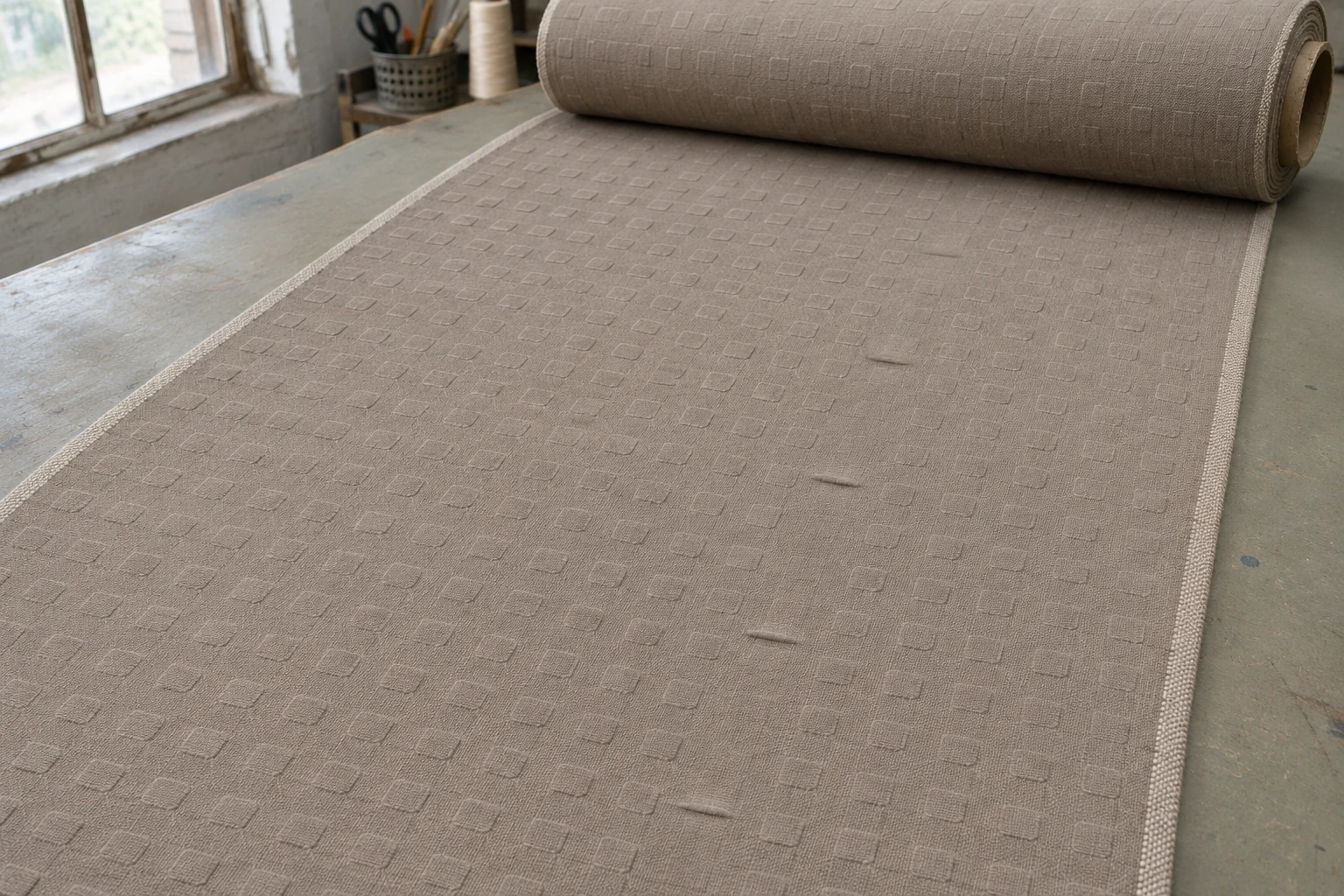
Identify the mark that differs from the intended embossed pattern. Find several matching marks along the cloth and measure between the same point on each one. Note where each sits across the width. If the spacing is close to the distance the cloth travels during one revolution of a roller, that roller and its associated contact points are worth checking. Compare the marks with the intended design repeat and with records of other rollers and process conditions. A spacing match gives the production team a place to start. The fabric evidence, equipment details and timing of the run are all needed to confirm the source.
Imagine taupe fabric embossed with small squares. The squares repeat in rows, but a short crosswise line interrupts a few of them near the right side. A little farther down the roll, another line of the same shape appears in a similar position, followed by a third. That sequence is worth measuring. Photograph the line with the normal squares around it so another reviewer can recognise the same feature. If it is easiest to see from one side, keep that close view with an overview that identifies its position along the fabric.
Look at the design across a wider part of the cloth before examining the detail. The orientation and boundaries of the intended repeat help distinguish an irregular feature from a pattern element. Put an approved reference beside the cloth if you have one, or look at a nearby area where the line is absent. A short mark may cross the tops of two squares, or it may appear repeatedly only in one lane across the width. Record the repeat of the design separately from the distance between the unusual marks. A regular square spacing can remain visible between them.
Lay the fabric face up in a consistent direction and let it rest on the same support. Use side light to see the change in shape, then diffuse light to see whether the mark also changes the sheen. A line can interrupt relief, appear as a shiny patch or fade as the angle changes. Include an intact motif in the close view. If the line appears over a gap or edge in the table, slide the cloth across the surface without turning it and see whether the mark moves with the fabric. Photograph the reverse at the matching position if you see anything there.

Record the roll identifier, face, direction and end from which you measure. Define left and right when looking along that direction. If a mark lies near the right, state whether its distance is from the physical selvage or from the edge of the usable width. A roll later opened from the opposite end will have a different length reading and the sides will appear reversed. Keep the original endpoints and record any seam or removed piece that will help orient the roll again. Put any removable markers beside the area you need to observe so they leave the relief visible.
Write a short description of the feature you are following. For example, “a short line across a square edge, perpendicular to the length and inside the right usable edge.” Record the size of the line and its position using the direction appropriate to each measure. The line may run across the width while its spacing from the next line is measured along the length. A note that only says “25 mm” can be hard to interpret without this distinction.
Choose the centre of a well-defined mark, or the same identifiable end if several start in the same way. Measuring from a centre to an end introduces a difference that comes from the choice of reference point. Take the length reading parallel to the direction of travel. If the mark moves sideways, measuring diagonally between marks adds part of the width difference. Record the width position separately. Keep the fabric flat without stretching it and show the measuring position in an overview. A colleague should be able to identify the same pair of points.
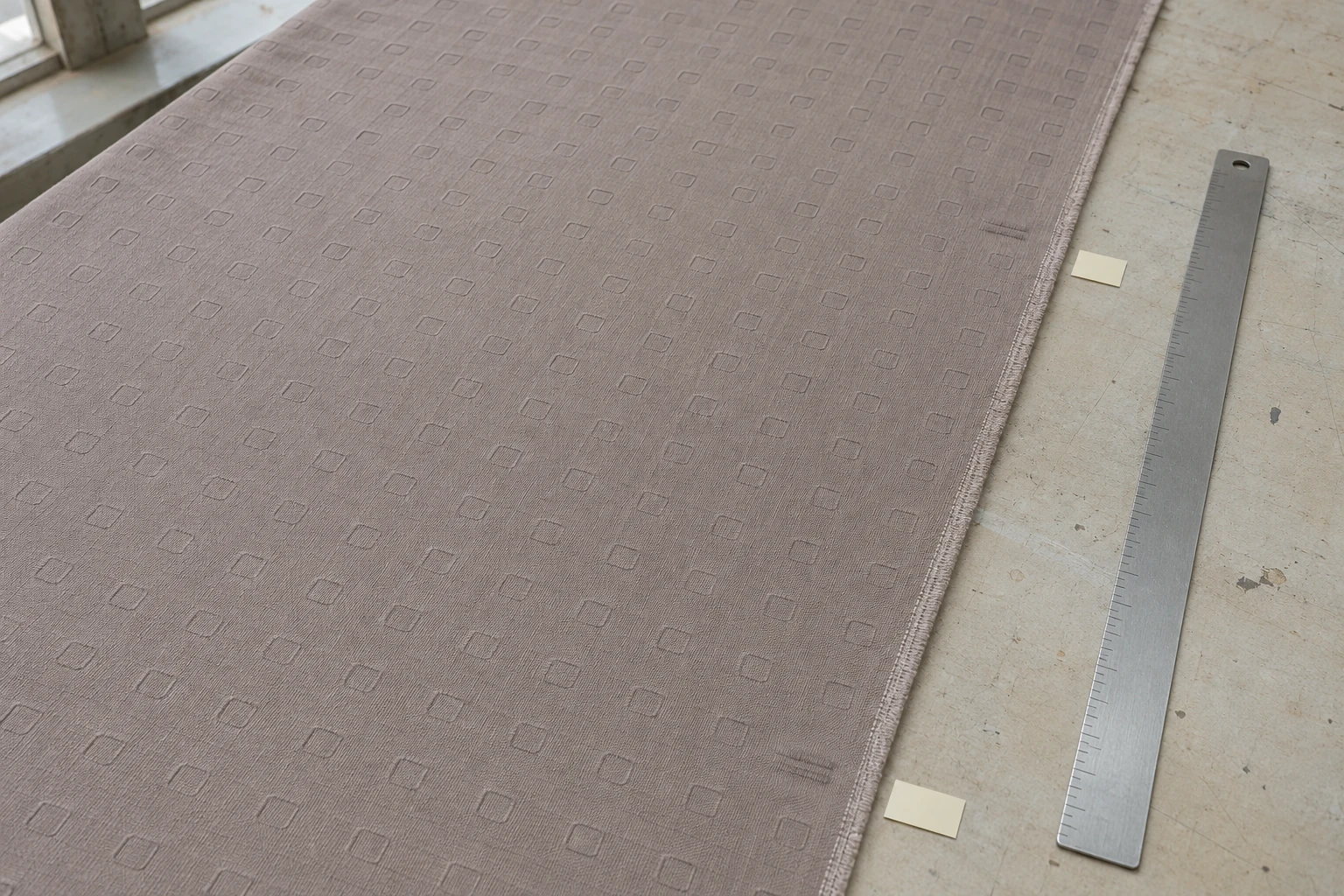
For example, imagine five marks of the same shape. Their centres are measured from one origin, and each interval is recorded against the previous visible mark.
| Mark | Distance from origin | Distance from previous mark |
|---|---|---|
| 1 | 1,240 mm | |
| 2 | 2,026 mm | 786 mm |
| 3 | 2,810 mm | 784 mm |
| 4 | 3,597 mm | 787 mm |
| 5 | 4,381 mm | 784 mm |
The shortest interval in this example is 784 mm and the longest is 787 mm. The distance from the first mark to the fifth is 3,141 mm. Divide it by the four intervals to get about 785 mm per interval. The example shows the overall spacing and the variation between individual readings. Record how you measured. A running length counter and a direct measurement on a relaxed piece can give different readings. Repeat the measurement between the same two marks if you need to understand how much of a small change comes from positioning or reading the ruler.
If one interval is roughly twice the usual length, look again around the expected intermediate point. A series of gaps around 785 mm followed by one around 1,570 mm may include a faint or missing mark. If you do not see a mark in an examined area, record it as “not observed” and keep the measured interval. Record any area you passed without examining it separately. If the spacing appears to widen after a seam or gradually shortens towards the end of the roll, keep separate sequences. An average across both segments could hide the change. Start another sequence if the feature or the position across the width changes as well.
When the contact diameter is known, multiply it by pi to find the circumference. For example, a roller with a diameter of 250 mm has a circumference of about 785 mm. If its surface and the cloth travel together without slip, and one mark is formed per revolution, the spacing along the cloth can be close to that circumference. The length of the cloth during inspection should also be comparable with its length at the point of contact. Ask the production team to confirm the working diameter, including any relevant cover, from its equipment information. The outside diameter of the wound fabric roll describes a different object.
If records show the fabric speed and roller rotation rate at the same point in the run, you can calculate travel per revolution from those readings. Dividing metres per minute by revolutions per minute gives metres per revolution. Convert to the same unit as your fabric measurements. If fabric and roller surface speeds differ, the pitch on the cloth can differ from the roller circumference. Stretch, shrinkage or slip can also matter. Where relevant, ask the production team to review those conditions before comparing the readings. Keep the run segment with the result and use speeds from the same time window.
Two marks at evenly spaced points per revolution could appear about half a revolution apart. Check whether they have the same form. If a strong line and a weak line alternate, record both and compare the spacing within each series as well. A single source that leaves a mark only on some turns could produce visible gaps of more than one revolution. Treat near matches to half, one or several revolutions as leads to check against the shape, position and sequence. If two rollers have similar working diameters, the figures can put both on the list. Ask which face each contacts and whether the corresponding strip of the cloth passes that contact.
A short mark that returns in the same lane can help identify where to compare contacts. A continuous lengthwise line has a different pattern and may have no distinct marks to measure along the cloth. Some bands run across much of the width. Record how far across the width the band reaches and whether each end looks the same. If the same roll contains short repeating marks and a longer line, map them separately. For each feature record where it starts, how wide it is and the direction it takes.
If a mark lands on the same part of the same motif each time, compare its position with the pattern repeat. On another roll, the line may cross a square once and sit between squares on the next repetition. Such a shift can indicate that the mark spacing differs from the intended motif spacing. Keep photographs that show both the phase relative to the motif and the position along the length. Other rotating elements or recurring vibration can produce a similar spacing. A match alone cannot distinguish among these causes.
Compare fabric from before and after embossing if such samples are available. A mark visible before embossing gives the team reason to review the earlier process stages. A feature first seen at a seam and ending a short distance later should be logged separately from one that can be traced through the roll. Use production time records to connect the first and last locations to the appropriate part of the run. If an equipment inspection is needed, give the record to the authorised team. The fabric map should make it clear what they are looking for and where it occurs.
Add the first and last observed positions, the lane within the usable width and the areas you actually examined to the roll record. There can still be unexamined areas between the outer observations. Look at the mark from the normal distance if the cloth will be used on a visible part. For example, a narrow affected lane near the edge may sit outside the cutting layout for one article and inside a wide front panel for another. Identify the intended piece, check the approved appearance for it and confirm whether the mark is visible outside the mapped lane. Before allocating an unexamined area, review it in the same orientation and light.
If the roll has already been divided, ask for the recorded length of each piece and any material removed between them. The distance between two marks on different cut pieces is useful only when both original positions can be located from the same origin.
If you separate a sample from the roll, record its origin and the length direction before cutting. Keep the larger photograph with its close view and the measurement view. A ruler in a photo is useful for showing placement, but use the direct measurement for the record. Send production the roll identifier, support or tension condition, mark positions and intervals, with an unmarked reference if available. Record the candidate roller and calculated pitch on their own line. State where you checked for a mark and did not see one. A second reviewer should be able to find the same area on the same face of the roll and apply the record to the cutting decision.
phone: +90 212 576 5250
fax: +90 212 493 0336
email: info@unlutransfer.com
Yenidoğan Mah. Eser Sok. No: 6-8
Bayrampaşa, 34030,
Istanbul / Turkey
TR 9150171175
Bayrampaşa Tax Office