For quick contact: +90 532 288 2200


Rei Kawakubo, Yohji Yamamoto and Issey Miyake showed which decisions beyond body measurements shape a garment’s outline. Kawakubo brought linings to the outside and repositioned fastenings. Yamamoto reinterpreted historical internal supports in outerwear. Miyake used pleats and openings to explore the volume a flat pattern could take on when worn.
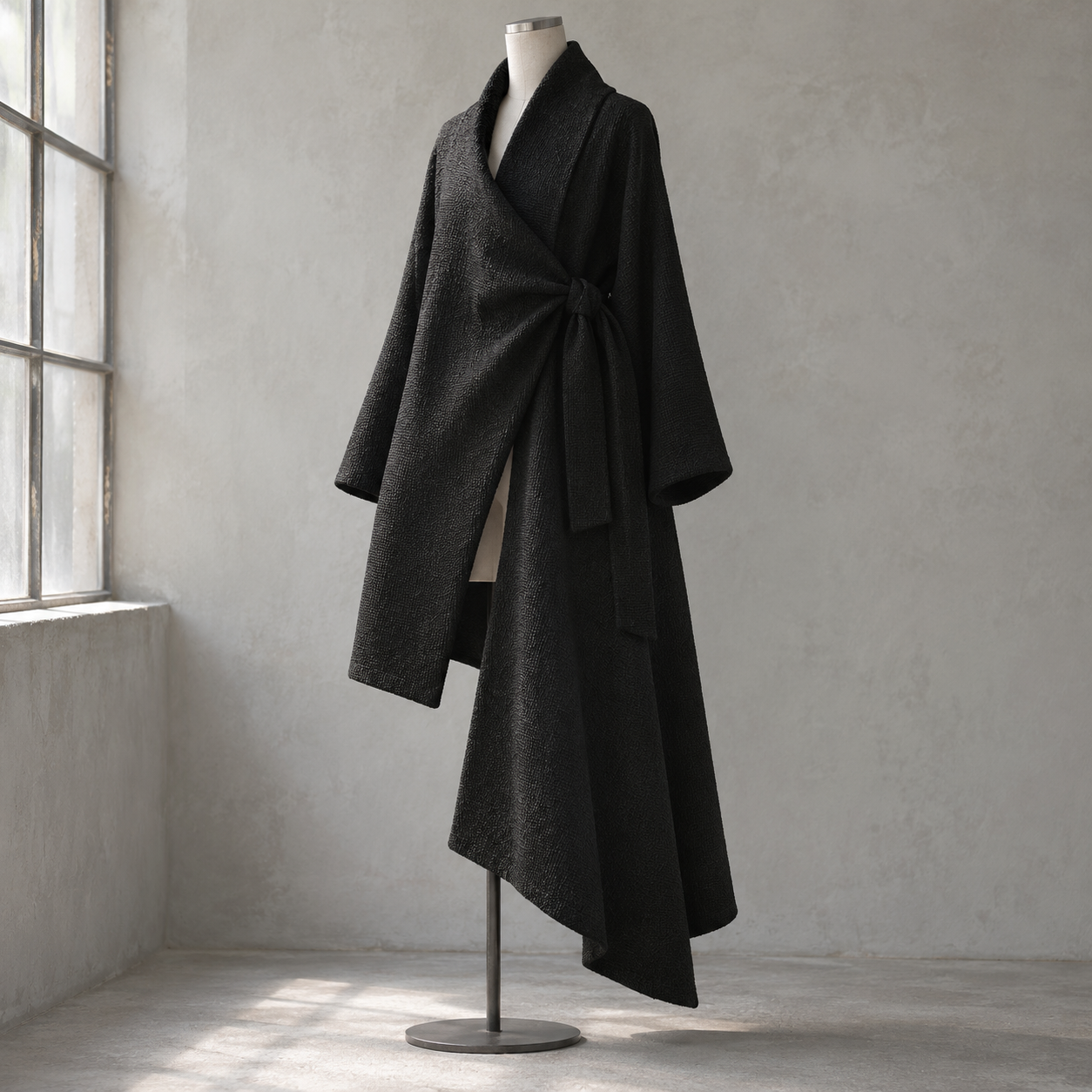
Representative illustration; not an actual production test.
When Rei Kawakubo and Yohji Yamamoto first presented their collections in Paris in April 1981, it was hard to tell where the body narrowed or widened beneath the asymmetrical black garments. The worn appearance of the fabric drew as much attention as the cut. Some European journalists dismissed the garments as anti-fashion, while others saw ingenuity and elegance in them. Today, those opposing assessments raise a question. When a garment’s outline departs from the curves of the body, what gives the silhouette its shape?
We can pursue that question by looking at the placement of a lining, the volume at the back of a coat or even where the wearer’s head enters a garment. Kawakubo’s and Yamamoto’s respective approaches to tailoring and Issey Miyake’s experiments with pleating flat geometric pieces offer three different ways into the question. To understand the shapes we see around the body in the work of all three, we need to look a little way in from the fabric’s outer edge to see how the pieces are cut and joined, and where they meet the body.
When the two sides of a garment mirror each other, the eye can more or less predict how a line will continue on the other side. In a close-fitting cut, the lines of the shoulders, waist and hips also help us make that prediction. Both cues became less reliable in the garments Kawakubo and Yamamoto showed in Paris. The differences between right and left drew the eye from one side to the other, while the fabric, by following no clearly defined body shape, left the distance between cloth and body uncertain. It became hard to explain the widest or narrowest point of the silhouette by looking at the wearer’s measurements.
The appearance of the fabric also affects how we perceive the cut. On a black surface, a break in the evenness of the fabric can guide the eye as much as the edge of a piece. This is why the textile innovations that accompanied the experimental pattern cutting in the 1981 collections matter. When worn-looking fabric and asymmetrical cuts came together, the signs of care a viewer expected from tailoring also changed. In the National Gallery of Victoria’s interpretation, these garments questioned the restrictive standards of beauty of the time. Qualities that someone looking for an even surface and a cut that defined the body might see as flaws were part of the elegance someone else saw in the same garment.
One concept the National Gallery of Victoria (NGV) associates with these works is *ma*, the Japanese term for negative space. To look at a garment through this concept is to shift attention from the space the fabric occupies to the gap it leaves around the body. Where the fabric stands away from the body, the width of that gap also determines the outline. The same interpretation links *wabi-sabi* to an appreciation of simplicity, irregularity and imperfection. This second concept brings the eye back to the surface. To appreciate a texture that looks worn, we may also need to reconsider what we regard as refinement in a fabric.
Garments constructed from flat pieces, a form derived from the kimono, offer another way to look at cut. For a flat piece to wrap around the body, its edges need not trace every curve of the body from the outset. What matters is where the edge reaches when the piece is wrapped, which face comes to the front when it is folded and where the fabric gathers when it overlaps another piece. Knotting, too, holds the fabric at a particular point and changes how it is distributed around that point. In a construction like this, the body still carries the garment, but the line visible from the outside also follows the direction given to the cloth.
The difference between wrapping and layering makes it a little easier to see how the contours of the body are abstracted. By following the edge of a wrapped piece of cloth, we can see the path it takes around the torso. When several layers overlap, the edge the eye follows conceals part of the piece beneath it. A line we see at waist level may then tell us very little about how narrow the waist is, yet show quite clearly how two surfaces meet.
The connections the museum draws are interpretations. Origami, for example, helps us think about how a flat surface can gain volume when folded. To conclude from this that the pattern for a particular garment shown in Paris was based on origami would require more concrete information about that design decision. Returning to the garments with these concepts in mind, we can discern more precisely where asymmetry arises. When an edge has no counterpart on the other side, we can trace its direction by looking at the space beneath the fabric, the overlapping surfaces and the points that hold the pieces together.

Someone putting on a coat sees the lining as they slip an arm into a sleeve. Someone facing them sees the outer fabric and the shape the coat takes when fastened. In *Coat, coat and skirt*, from her autumn–winter 1998–99 collection *Fusion*, Kawakubo brought these two viewpoints together on the same surface. She brought the linings to the outside and repositioned the fastenings. Two distinct construction decisions that a wearer notices when putting on a garment became clues that an observer, too, could follow to understand the silhouette. Which fabric faces inward? Where are the pieces fastened together?
The two coats named in the title and the skirt that accompanies them suggest the scope of Kawakubo’s collage. She brings together both mismatched fabrics and different garment forms. Once we recognise one piece as a coat and another as a skirt, we also begin to notice where each joins the other. The difference between the fabrics keeps that transition visible. Moving a fastening to an unfamiliar place draws the eye away from what we assume to be the front of the garment. To make sense of the whole, we now have to follow which piece lies over which and where their edges meet.
In this work, the approach known in the 1990s as deconstruction can be seen in the way the tailor’s decisions remain legible on the garment. Seeing a lining reminds us which surface we would expect it to cover. Where two mismatched fabrics meet, we realise that concealing the transition between them would itself be a tailoring choice. This is the basis for the NGV’s observation about what makes a garment appear finished. In a work that viewers might perceive as still under construction, where and how those traces appear can be a design decision in its own right. The signs by which we judge a garment complete therefore matter.
For Yamamoto, the interior of a garment was also a way to investigate how historical silhouettes were constructed. The fullness visible at the back of a nineteenth-century garment might come from a bustle supporting the fabric from below. To understand the curve we see from the outside, we need to consider both where the fabric would fall under its own weight and what support holds it in place at which point. In the 1990s, Yamamoto reinterpreted Victorian bustles in contemporary outerwear. During the same years, he also adapted the draping of Edwardian dresses from 1900–10 to contemporary silhouettes. With a bustle, we think of the support beneath the fabric that holds it away from the body. With draping, we can follow with our eyes the direction in which the fabric gathers and falls.
The *Bustle coat*, from the autumn–winter 1995–96 collection *Black*, playfully reinterprets the Victorian *visite* coat. Although the title names the bustle, the coat appeared on the runway without its tulle bustle. That detail matters when picturing the silhouette. Someone familiar with the coat’s historical reference is likely to imagine a support holding up the fabric at the back. It would be misleading to judge the runway silhouette as though the tulle bustle had been there.
Considering the two designers’ coats side by side brings out two aspects of the relationship between the inside and outside of a garment. We can see the lining Kawakubo brought to the outside. With Yamamoto’s coat, knowing that the title names a bustle changes what we look for when we view the garment from the side. In one coat, the fabric we recognise from the inside is before our eyes. In the other, the volume we remember from a historical garment helps shape our perception even when the coat is shown without its tulle support.

When Miyake and his team began experimenting with pleating polyester garments in 1988, the fabric had already been cut and the pieces sewn together. Applying the pleats after sewing meant they could continue to shape the whole garment even after its pieces had been joined.
By 1993, the transition from flat pattern to volume in the *Pleats Please* line could be traced through four interrelated decisions. The first was to base the pattern pieces on flat geometric shapes. If we saw one of these pieces laid flat, we could follow its edges and easily tell where the surface began and ended. That information alone would tell us little about how the same piece looked on the body. One part of the fabric might face forward while another turned to the side. Two edges that seemed far apart when flat might come close together around the body. Miyake’s cut offers a clearly defined starting shape for exploring the difference between those two views.
The second decision was to shape the geometric surface with narrow, linear pleats. Imagine looking at a fold in cross-section. The fabric extends in one direction, then turns back along the other face of the fold. Repeating this movement side by side changes the relationship between the area the flat piece covers and the area the folded surface covers. The lines running through the piece begin to define its shape as much as its outer edge does. Because the two faces of a pleat point in different directions, fabric that the eye could take in as a single plane now reads as a surface with depth.
Colour blocking plays a visual role in this exploration. The pattern line marks the boundary of the piece, the pleat line shows the direction of the fold, and colour determines which area the eye reads as a whole within the same surface. When the garment encircles the body, our perception of volume also depends on how much of a block of colour is visible from the front and how much continues around the side. A colour boundary alone cannot tell us whether the fabric was cut there. Following the course of that boundary across the garment can, however, help us see where the fabric turns.
The fourth decision concerned the unusual placement of the openings for the head and arms. Without knowing where the head will pass through a flat geometric piece, it is difficult to predict where any given edge will fall on the body. To see this, imagine shifting the head opening while keeping the outer edges of the piece fixed. As the opening moves closer to one edge, less fabric remains between the head and that edge, and more remains in the other direction. The placement of the armholes also affects which part of the fabric stays around the torso and which part extends to the side with the arm.
Someone looking at the flat pattern can immediately make out the geometry of the piece. To recognise that same geometry when someone is wearing the garment, the viewer has to start at the openings for the head and arms, then follow the pleats and areas of colour as they pass around the body. The relationship between cut, pleats, colour and openings makes this transition understandable. These principles alone cannot tell us the dimensions of the openings, the width of the pleats or the method used to set the folds, details we would need to reconstruct the pattern of an individual dress.
Miyake’s *Flying saucer dress*, from spring–summer 1994, pays homage to the *Akari* light sculptures of the Japanese American artist and furniture designer Isamu Noguchi. The dress’s name calls to mind the outline of a flying saucer. Its connection to *Akari* draws attention to the space enclosed by the fabric. Looking at how far the fabric extends from the shoulder, we can see how this space, too, contributes to the volume of the dress.
The *Starfish dress*, from autumn–winter 1999–2000, translates the fluidity of water and marine life into the form of a garment. In the *Flying saucer dress*, the space enclosed by the fabric helps us grasp the volume. In the *Starfish dress*, what stands out is how the fabric changes direction as it passes from one face to the next. We can also see the dress’s affinity with the sea in the movement its surface sustains through these turns.
From the asymmetrical black garments shown in Paris to these two dresses, perhaps the most revealing way to look at a silhouette is to trace a curve we see on the outside back towards the interior. In Kawakubo’s coat, that trail leads to the exposed lining and the repositioned fastening. In Yamamoto’s coat, we think of the bustle we would expect to support the fabric from within, and of its absence on the runway. In Miyake’s dresses, the eye travels from the surface that wraps around the body back to the flat piece and its narrow folds. Each time, the curve we see tells us something different about the body, because a different design decision has determined how the fabric approaches it and where it stands away.
phone: +90 212 576 5250
fax: +90 212 493 0336
email: info@unlu-group.com
Yenidoğan Mah. Eser Sok. No: 6-8
Bayrampaşa, 34030,
Istanbul / Turkey
TR 9150171175
Bayrampaşa Tax Office