For quick contact: +90 532 288 2200


Dye supply, improvements in production methods, recorded recipes and sample testing supported 19th-century efforts to reproduce colour over large quantities of fabric. Synthetic dyes brought economic advantages, but reproducibility, shade uniformity and the colour’s durability in use remained distinct properties that needed separate assessment.
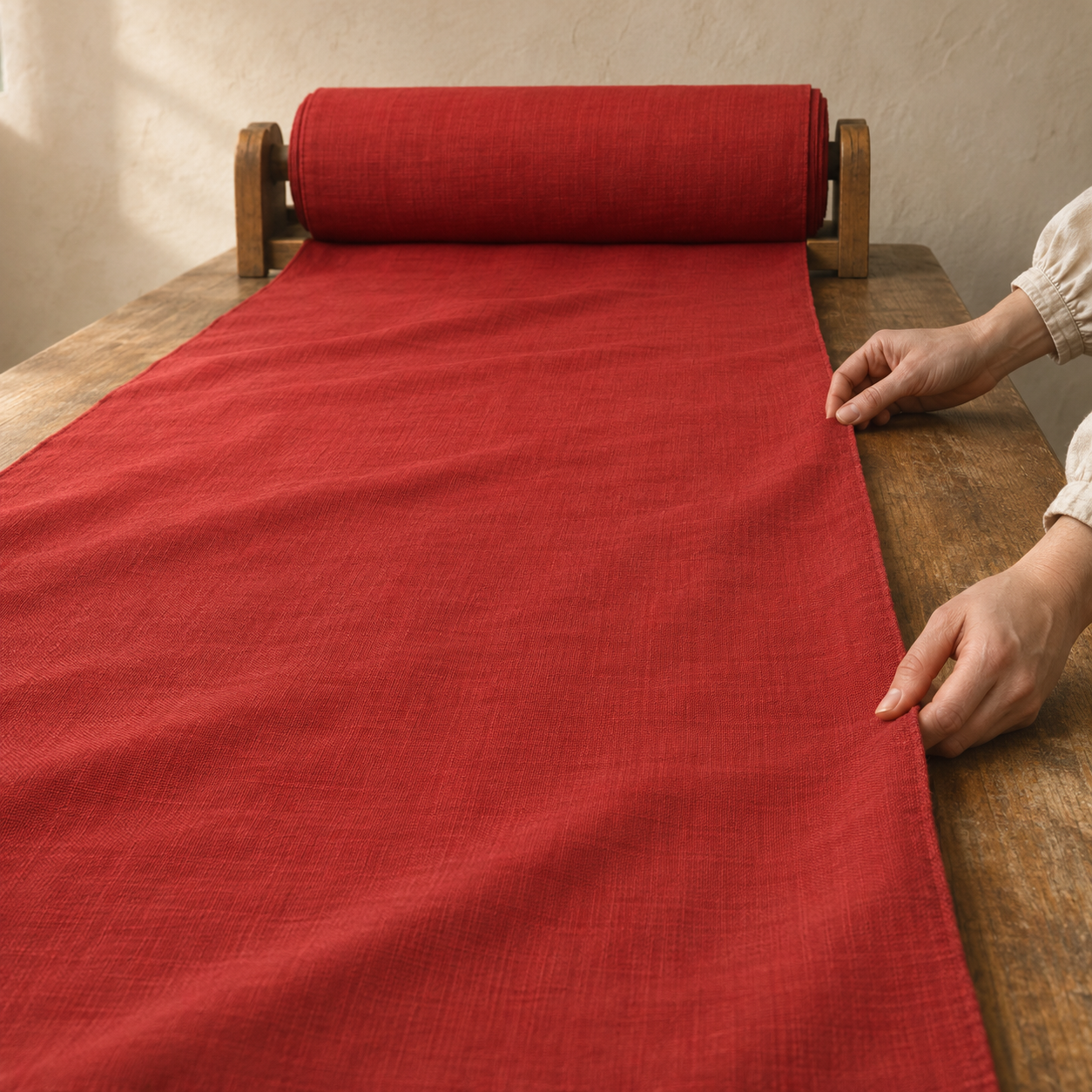
Illustrative inspection scene: levelness concerns how evenly colour appears along the fabric.
As textile manufacturing industrialised, colour consistency became a concern involving thousands of yards of fabric and large numbers of garments. The colour achieved in a sample was expected to be maintained in large-scale production and reproduced in later production runs. This expectation had two distinct dimensions: an even shade along the fabric and matching results from dyeing carried out at different times. Obtaining enough dyestuff was the starting point; repeating the application process was also a production problem to solve.
Natural dyestuffs were also part of the large-scale textile industry. In the 19th century, Turkey red cotton dyeing, which used alizarin obtained from madder, had grown into an industry employing thousands of people and supplying fabric to world markets. Known for its bright red colour and resistance to washing, the process shows that a naturally sourced dyestuff could be used in large production volumes. An account of the industrialisation of dyeing therefore needs to consider the production experience built up before synthetic dyes.
The supply of plant-based dye raw materials, however, depended on harvests. As production grew, this dependence and the cost of raw materials became more significant. The relatively low prices and wide range of colours offered by synthetic dyes were attractive for large-scale production. Making dye economically accessible eased one of the conditions for producing large quantities of fabric. Whether that advantage translated into an even shade on the fabric depended on how the dye was applied.
William Henry Perkin’s work after his discovery of the purple dye mauveine in 1856 reveals the distance between laboratory and factory. Perkin developed methods for obtaining the starting materials needed for production in large quantities and established a factory at Greenford Green. The discovery of a new colour thus reached industry through work on raw-material production and the establishment of a manufacturing site. For the dyestuff to find a place in textile manufacturing, it had to be prepared in the quantities required.
Changes in Turkey red show how an established dyeing process could be improved at different stages. When synthetic alizarin entered commercial production in 1869, dyers began turning to a more concentrated, less expensive dyestuff without woody residues. Their reasons for choosing it concerned the material’s contents and cost. During the same period, the time needed for preparation before dyeing also mattered to production.
In the Turkey red process, which used oil and alum, the adoption of Turkey red oil in the 1870s removed the need for repeated oiling and shortened preparation. Synthetic alizarin brought a change in the dyestuff, while the oiling innovation affected processing time. Scaling up production thus involved improving the process steps as well as the raw materials. This example specifically concerns the Turkey red process used on cellulosic fibres such as cotton; the same change cannot be assumed to produce the same result in every dyeing method.
Preserving production knowledge provided another basis for efforts to reproduce colour. Manufacturers documented their colour-making processes so they could apply them again. Books and notebooks dated 1862–1893, examined by the Dye-versity research in Glasgow, contain industrial dyeing recipes alongside fabric samples. The written instructions described the procedure, while the piece of fabric provided a physical reference for the resulting appearance. Together, they created a more concrete record of production knowledge than a colour name alone could offer.
Recording a recipe does not mean that the result will automatically be the same. Assessments of samples also show that shade uniformity and durability were considered separately. The archival description of the Stevens Companies dye sample book dated 1889–1891 states that dyes were tested for colourfastness and evenness of shade. Shade uniformity concerns the even appearance of colour across a dyed surface. Colourfastness describes the colour’s resistance to influences such as light or washing. The record establishes that both properties were tested; it does not provide the test methods, acceptable shade differences or success rates.
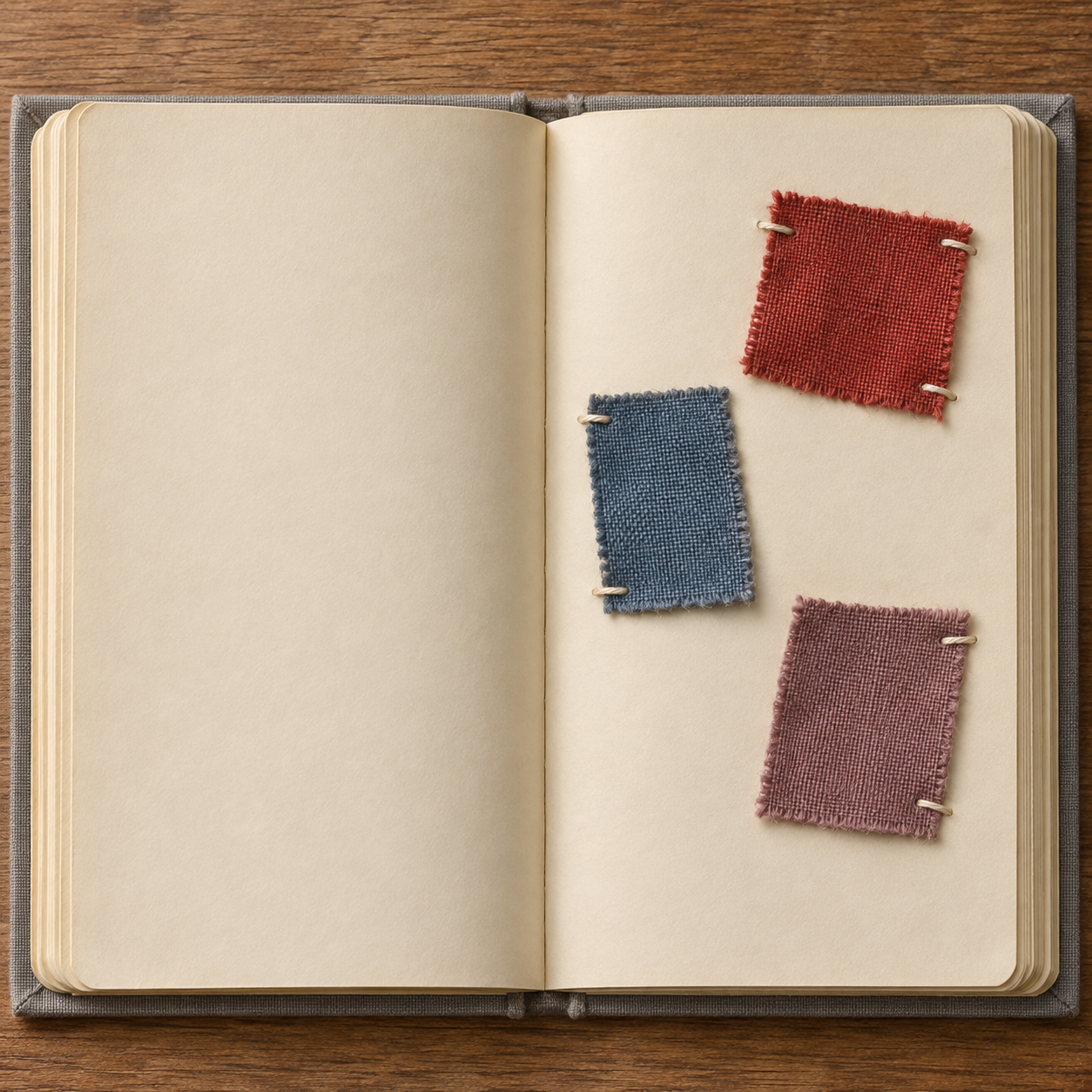

Modern chemical analyses of archival samples reveal another aspect of consistency. The 212 samples examined in the Dye-versity research were grouped into 11 characteristic chemical profiles. Marked chemical consistency was found in the purple, blue and magenta dyes. This finding provides information about the composition of the dyes examined. Demonstrating that a long piece of fabric was dyed to the same shade from end to end, or that different production batches matched in appearance, would require comparisons directly examining those properties. Chemical similarity between samples does not replace such measurements.
Recipes and fabric samples in historical dye books served as references for later dyeing. Recording a recipe did not guarantee the same result.
This concerns an even appearance of colour across a dyed surface. Chemical similarity between samples does not show that an entire length of fabric has the same shade.
This is the colour’s resistance to effects such as light or washing. Recorded light-induced fading of a historical mauveine-dyed silk garment is one example; it does not establish the same fading rate for all fabrics.
The symbols in this schematic comparison are illustrative; they do not show a process sequence, measured shade differences or fading rates. Chemical similarity between samples alone does not prove visual colour matching along a fabric or between dyeing batches.
The distinction between reproducing a colour and preserving it over time is particularly clear in early synthetic dyes. Magenta and methyl violet dyes were used for more than forty years despite their known sensitivity to light. Their long commercial use is not evidence of high lightfastness. Light-induced fading recorded on a mauveine-dyed silk garment dated 1862–1863 in the Science Museum Group collection makes this distinction tangible. The object offers an example of light’s effect on colour; it does not show that all mauveine-dyed fabrics faded at the same rate.
These distinctions help identify which evidence answers which question when assessing success in historical dyeing. Raw-material and factory records describe how production was scaled up, recipes show how manufacturers tried to recreate colour, and tests indicate which properties were checked. Establishing measured shade uniformity over long lengths of fabric also requires fabric and batch comparisons. Understanding the success of a historical dye means examining the colour obtained, the conditions under which it could be reproduced and the influences it could withstand.
phone: +90 212 576 5250
fax: +90 212 493 0336
email: info@unlutransfer.com
Yenidoğan Mah. Eser Sok. No: 6-8
Bayrampaşa, 34030,
Istanbul / Turkey
TR 9150171175
Bayrampaşa Tax Office